Calibration Products
Calibration Products
Please send any comments and updates to: dd@space.mit.edu.
Go to HETG at XRCF
The purpose of this document is to describe the various
"calibration products" that are involved in the HETGS calibration.
This section provides a general overview to the products, the
next sections provide more specific descriptions of the types
of products and the HETGS products themselves.
Calibration Data is the starting point for
all calibration activities.
These data can be analyzed to produce specific results, or
Calibration Measurement Products.
Calibration synthesis activites will then examine, understand, and
cross-check the various Calibration Measurement Products to produce a
set of well-defined Calibration Interface Products that
faithfully describe the instruments and can be used by others (e.g., for
data analysis, ray-trace simulation, proposal planning, etc.).
A sub-set of these CIPs will be Fundamental Calibration
Products that are used as a starting point to calculate the other
products in a relatively automatic fashion.
Finally, it is useful to explicitly identify those data that
are needed by the ASC Data System for data analysis - these are
called Analysis Reference Data.
A graphical expression of these ideas is given below:

- These are raw data taken at sub-assembly, at XRCF, in flight.
They are just data (counts, spot location, event file, etc.). Of
course they are the basis of the calibration. Error estimates are
an important ingredient of the data.
- These products cover many levels of complexity and represent the
results when the raw data
have been "analyzed" to create something, for example:
- "counts per second in
the Al-K BND bump"
- "HRMA-HEG effective area"
- "Grating HA1023 period
variation rms"
- "HRC count-rate correction for measurement
G-IHS-CR-10.001"
- "witness flat reflectivity at 8.04 keV"
- "HRMA effective area at 1.5 keV"
- "ACIS-I 5 arc min Mo-L off-axis encircled-energy curve"
There are lots of these! And their meaning and organization and
synthesis can require a lot of human knowledge. Many results
may be ammenable
to database storage, others may require memos to describe and define them.
Again, error estimates are produced for each result as well.
- The wealth of calibration measurement results must be sythesized,
resolved (e.g., synchrotron witness vs. reflectivity lab vs. XRCF
effective area predictions), distilled, and
captured (along with error bars) into some finite comprehensive
well-defined set of data that serves to model the component.
For example, for the HETG, there will be a fundamental set
of data at the grating facet level that will predict/describe the
instrument when combined with similar data/models for the other system
components. Initially "filled" with sub-assembly data, we need to
develop ways to "perturb" these fundamental products to have a best
agreemement with sub-assembly, XRCF, and eventually flight calibration
data.
Or, for the HRMA, the Fundamental Calibration Product
is the combination of the SAOSAC
models of figure plus scattering plus Ir reflectivity models--these
make up the most fundamental HRMA model and any "tweaking" to it will
probably happen in this context.
- The "problem" with these fundamental calibration products is that
they are usually not what we want for many applications. So, for
example, the facet-by-facet efficiencies are turned into
shell-by-shell efficiencies that are combined with mirror
shell-by-shell reflectivity and areas and combined with ACIS-S chip
quantum efficiencies and geometry to finally produce the HETGS
First-order effective area vs energy.
"Calibration Interface Products" are well-defined,
generally useful, products that are derrived from the fundamental
calibration products (often from more than a single component).
Requiring an understanding of the fundamental calibration products,
these interface products are best generated under Cal and IPI guidance
and/or s/w.
- The last set of data that we generally put under the term
"calibration products" are the very specific parameters and files that
the ASC data system analysis software will use. These are dictated by
the analysis algorithms (is a 2D PSF matrix desired? is an EE curve
needed?) and by the analysis software formats and standards (FITS
file? ASCII? binary? compressed? portable?). These formats are
dictated by the analysis algorithms and software architecture;
i.e., their requirements are produced by SDS.
Calibration activities can then help with the "filling-in" of
the actual values of the data.
These products will be stored in the ASC archive. Thus there is
a single source for the values. The values are also revision controlled
so that changes (improvements) can be incorporated. Some values
may be time dependant and the archive can handle that as well.
Most of the data files/tables are in a simple ASCII tab-delimited
rdb format. The IDL procedure
rdb_read.pro
can be used to read in these data.
-
- Types of HETG calibration data:
- Synchrotron Data
- Synchrotron data is in: /nfs/wiwaxia/d4/ASC/data/SYNCHROTRON/
- General grating information. See HETGgratings.rdb in Measurement
Products section below. This general information combines an assortment
of sub-assembly summary data:
- Spread sheet of gratings is in /nfs/fuzzy/h1/tgs/results/ as
the most recent GratingStatusYYMMDD.txt file (which would include spares production).
Relevant columns of this spread sheet for the flight gratings are
available as HETGgratings.rdb.
- LR summary data is stored in 'results/GratingStatus.lr.txt and
appears in columns of HETGgratings.rdb.
- Some crude X-GEF summary data from GratingStatus.xgef.txt is also in
columns of HETGgratings.rdb.
- Fabrication Lot Parameters
- Spread sheet of grating Lot parameters is in 'results as
the most recent LotIndicatorsYYMMDD.txt file (to include spares production).
-
Sub-assembly Data: LR and X-GEF
- Original LR data files are in: /nfs/fuzzy/h1/tgs/lr/dat/ .
- Original X-GEF data are on DAT tapes (MIT and ASC copies)
- X-GEF analysis products are on caliber, spectra, and
bodicea hard disks, as given in the file 'results/XGEF_valid_dirs.txt .
- X-GEF testing and analysis yields diffraction efficiency model
paramters for several regions on each flight grating, the HETG_shellN_multi.rdb
files, see sub-assembly efficiency.
- HESS metrology
- data are in ~dd/wave/hess/Metrology/
- Alignment Data
- PC-generated data files in the alignement lab contain the
raw PEM alignment data and the analyzed result: each facet's
installed roll error. These final roll error values are
available in a column of HETGgratings.rdb.
- XRCF Data
- All HETG XRCF data have been acquired with the XRCF focal plane
detectors and so are available through the usual sources.
-
- Types of HETG calibration measurement products:
- Synchrotron
- HESS design: location and orientation in space of facets
- HETG gratings: general/summary information (fab lot, average period,
etc.) and lab-measured alignment values
- LR
- LR average period and dp/p for each facet are in columns
of HETGgratings.rdb.
- LR period and roll variation maps to come.
- LR absolute period calibration
- X-GEF
- See the facet diffraction model parameters in the FCP section.
- XRCF Effective Area related
- XRCF Line Response Function related
-
-
Given i) the variation among the HETG facets in both period
variations and efficiency, ii) the misaligned gratings and iii) the
fact that different azimuths of the HRMA scatter in different
directions it is reasonable to have the fundamental products for the
HETG at the grating level.
The sub-assembly data are naturally at this level. A key calibration
task will be to use XRCF results to adjust and issue updated
values for these products (e.g., including scatter, adjusting efficiency).
The HETG FCPs, then, include the
following:
- memo:
http://space.mit.edu/HETG/hess/basic.html
- data:
http://space.mit.edu/HETG/hess/HESSbuilt.rdb
-
- HESS as built: location and orientation in space of facets and
their dispersion directions. Currently this is identical to
HESSdesign.rdb; in future HESSbuilt.rdb will be produced once XRCF analysis
of mis-aligned gratings is complete.
- memo:
http://space.mit.edu/HETG/hess/gratings.html
- data:
http://space.mit.edu/HETG/hess/HETGgratings.rdb
-
- facet average period and dp/p rms values, in "LR Angstroms".
- memo:
http://space.mit.edu/HETG/effic/sub_ass_effic.html
- data: HETG_shellN_multi.rdb files
-
- each facet: diffraction efficiency (E,m) model parameters for
X-GEF tested regions
FCPs in development:
- each facet: period map over active area
- each facet: roll-angle deviations map over active area
- Au optical constants for diffraction model
- Polyimide, platingbase transmission model (part of efficiency model)
- method to include grating (HEG) scatter approximation
-
The fundamental HETG data above can be processed to produce several
useful CIPs that do not (or not strongly) depend on information
about other components. Each CIP set of data has a corresponding memo
which describes how the values were produced. The HETG CIPs available
are listed below:
- memo:
http://space.mit.edu/HETG/hess/basic.html
- data:
http://space.mit.edu/HETG/hess/HETGbasic.rdb
('LETGbasic.rdb)
-
- HETG Rowland Diameter (NOT Rowland spacing!)
- Effective ring radii (shell)
- HETG vignetting term (shell)
- memo:
http://space.mit.edu/HETG/period/period.html
- data:
http://space.mit.edu/HETG/period/HETGperiod.rdb
('LETGperiod.rdb)
-
- HEG, MEG effective average period
- HETG Rowland spacing (X/F)
- HETG opening angle (X/F)
- HETG mean dispersion angle (X/F)
- HEG, MEG angles (X,F)
- memo:
http://space.mit.edu/HETG/core/core.html
- data:
http://space.mit.edu/HETG/core/HETGcore.rdb
('LETGcore.rdb)
-
- HEG, MEG dp/p rms
- HEG, MEG roll rms
- memo:
http://space.mit.edu/HETG/effic/effic.html
- data format:
http://space.mit.edu/HETG/effic/HETG_shellX_effic.rdb
- The above .rdb file is an example of the efficiency format.
The full set of 14 data and error files are available
at MIT in /nfs/spectra/d6/CIP/ and below as
gzip'ed rdb files:
- HETG efficiency (E, m, shell)
- HEG, MEG effective efficiency (E, m, HEG/MEG)
- HETG effective efficiency (E, m)
- memo: see Section 9.3.5, MARX Parameters, of the HETG
Ground Calibration report.
- data: see marx.par
-
These parameters are a good example of CIPs that are created from other
CIPs.
- HETG MARX parameters
- LETG MARX parameters
- memo: http://space.mit.edu/HETG/lrf/lrf.html
- data: http://space.mit.edu/HETG/lrf/HETGlrf.rdb
-
These CIPs represent advanced Line Response Function effects
that are not yet (Aug.97) in a form for release
("hopeless but not serious" as Peter Predehl would say!).
- HEG, MEG dp/p distribution
- HEG scattering contribution
- MEG mis-aligned gratings
To carry out XRCF data analysis and to create flight HETGS CIPs,
we need CIPs from the HRMA, ACIS, HRC, Aspect system, and
XRCF-specific information. These are listed below.
Note that these .rdb files represent a synthesis of the complete
calibration process for these components; links with more
details are given when available.
[Summary plots in ( )'s below were made with
cip_other_plots.pro.]
-
- HRMAbasic.rdb Focal length, etc.
- hrma.rdb
HRMA effective area (E, shell, "into 2pi"), on-axis, including features on the E/2000 scale (Converted to UserSupport energy grid from the original
data:
ping_hrma.rdb
,
ping_note.txt
.)
Note: For flight effective area predictions ("NRA") an additional
factor of 0.9 is applied to these HRMA areas as a prelude to XRCF corrections.
- HRMA Scattering files for MARX (XRCF on-axis and Flight versions)
- Optical constant values for HRMA Ir coating (MARX)
- HRMA P,H tilts and offsets for MARX (XRCF on-axis and Flight versions)
- Fit parameters (cubic) to HRMA[13,46] effective 1-D sigma vs E (see sec. 2.2.1 in HETG Prelim Cal Report)
- HRMA PSF parameters (E, shell ):
parametrized version of the 2D on-axis, nominal-focus image for each shell
(or 13, 46 pairs) vs energy.
[Larry David and John Everett work in process]
For off-axis, defocussed:
- HRMA effective area (E, shell, off-axis)
- HRMA PSF parameters (E, shell, off-axis, defocus)
-
- ACISbasic.rdb
ACIS simple pixel spacing, on-axis aim point location
- ACIS detailed chip geometry/metrology
- acis_qe.rdb
ACIS QE (E, chip=FI,BI, grades=0,2,3,4,6[ASCA])
- ACIS Grade/family definition (see
asca_of_flight.pro)
- ACIS QE spatial variations
- acis_fil.rdb
ACIS Filter Transmission (E, I or S array)
- ACIS filter spatial variations
- ACIS-S spatial blur parameters (E, chip) [Are there any spatial effects?]
- ACIS energy conversions
acis_gain.fits (more human readable:
acis_gain.dmp)
- ACIS-S PHA response matrices (E, chip, x, y),
available
from the ASC
-
-
HRCbasic.rdb HRC basic parameters: pixel sizes, plate sizes, gaps, angles (
HRC-S geometry)
- hrc_uvis.rdb HRC UV Ion Shields transmission
(HRC calib link:
uvismodel.html)
- hrc_hesf.rdb HRC HESF reflectivity
- hrc_qe.rdb
HRC MCP QE (at XRCF and for Flight)
- Parametrization of HRC QE and gain variations with position (E)
- HRC spatial blur ( 18 um rms in MARX currently)
- HRC degap parameters and algorithm
- HRC other PSF effects: e.g., ghost image parameters
- Parametrization of HRC PHA distribution (E)
-
- Aspectbasic.rdb Aspect basic parameters: reconstruction blur
- Nominal dither pattern for HETG observation
-
-
tot_req_run.cmdb local version of req_run.cmdb. Modified as
noted in
cmdb_mods.txt to better
agree with real XRCF events.
-
trw_mod.rdb modified "newtests" rdb file giving run_id and
MST irig (date/)time for each trw id. The characters "NULL" are added to
the irig field to help select the desired runid from multiple/invalid ones.
-
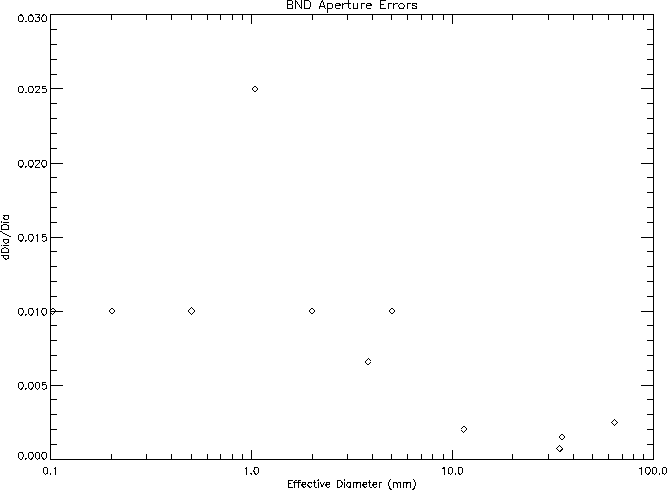
hxds_distances.rdb
-
bnd_aperture_areas.rdb
(
plot of effective diameter error)
-
fpc_x2.fit.rdb rdb file of FPC_X2 QE
(used to convert counts/s to photons/s for focal plane.) [from Edgar et al.,
stored locally in /nfs/spectra/d6/HXDS/]
-
fpc_5.fit.rdb rdb file of FPC_5 QE
(used to convert counts/s to photons/s.) [from Edgar et al.,
stored locally in /nfs/spectra/d6/HXDS/]
-
fpc_hn.fit.rdb rdb file of FPC_HN QE
(used to convert counts/s to photons/s.) [from Edgar et al.,
stored locally in /nfs/spectra/d6/HXDS/]
-
ssd_5_bessy_qe.rdb rdb file of SSD_5 QE
(used to convert counts/cm^2s to photons/cm^2s for BND and SSD_X.) [from Edgar et al., stored locally in /nfs/spectra/d6/HXDS/]
-
hxds_hsi_qe.rdb rdb file of HSI QE.
- HSI um/pixel (6.42368) and angle of axes at XRCF (-0.5181 degrees w.r.t. HXDS stages).
- HXDS Locations files
- HXDS stage and shutter files
- FAM locations vs time
- Non-monochromator BND analyses
- Monochromator BND analyses
- It is useful to define and create CIPs for the
complete HETGS by using the FCPs/CIPs of the HETG, HRMA, ACIS,
and including the Rowland Geometry and Aspect effects.
Most of these are "facility dependent": that is different for XRCF
and for Flight, so an XRCF and a Flight set of these is implied.
- memo:
http://space.mit.edu/HETG/res_power/res_power.html
- data: see table below
-
- HEG, MEG resolving power (E, m)
- memo:
http://space.mit.edu/HETG/eff_area/eff-area.html#ACIS
- data: see table below
-
- HETGS, LETGS effective area (E, m, ACISmode, cross-disp-mode)
- memo:
http://space.mit.edu/HETG/eff_area/eff-area.html#HRC
- data: see table below
-
*This file includes HRC-S spatial variation effects, see
http://space.mit.edu/HETG/eff_area/eff_area.html#HRC
- HETGS, LETGS effective area (E, m, HRC settings, cross-disp-mode)
Other HETGS CIPs not yet available:
- HETGS-HEG,MEG LRF distribution parameters (E, m)
- HETGS-HEG,MEG cross-dispersion distribution parameters (E, m)
- XSPEC response matrices for an on-axis, nominal-grating-dithered
point source that is analyzed (telemetry --> dispersed-energy histogram) by
the nominal ASC pipeline method.
In addition to the "on-axis, nominal focus" products, above,
it may be useful (but perhaps beyond the calibration task) to
generate products for the more general slightly-off-axis
(< 30 arc seconds TBR), slightly
defocussed (|dx| < 0.25 mm) case. These might include:
- HRMA-HEG, HRMA-MEG effective area (E, m, HEG/MEG, off-axis)
- HETGS-HEG,MEG 2D PSF distribution parameters (E, m, off-axis, defocus)
- HETGS-HEG,MEG LRF distribution parameters (E, m, off-axis, defocus)
- HEG, MEG resolving power (E, m, off-axis, defocus)
- HETGS-HEG,MEG cross-dispersion distribution parameters (E, m, off-axis, defocus)
- HETGS-HEG,MEG effective area (E, m, ACISmode, cross-disp-mode, off-axis)
- XSPEC response matrices (off-axis, defocus)
Summary
- This document focusses on the Calibration end of things, so
the ARD is not detailed here - and just as well because SDS/DS is
doing it... See for example: