Next: First Results Up: CCD Subpixel Structure Previous: Introduction and Motivation
Next: First Results
Up: CCD Subpixel Structure
Previous: Introduction and Motivation
 holes compared to the 24 size of a pixel) placed in a
regular fashion
holes compared to the 24 size of a pixel) placed in a
regular fashion![[*]](icons/foot_motif.gif) .
When this mesh is placed close to the CCD surface and
rotated with respect to the axes defined by the gate structure and channel
stops, a moiré
pattern is formed when the device/mesh combination is
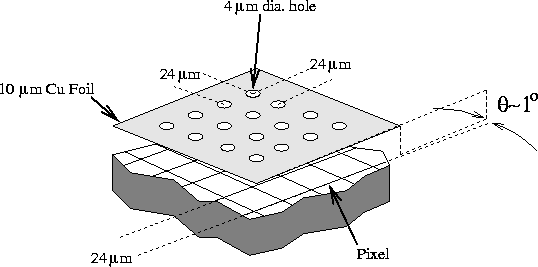
illuminated with X-rays. Figure 4.36 shows a section
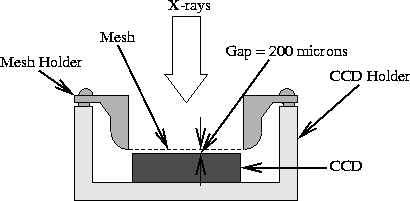
of the mesh, and Figure 4.37 shows the fixture used to
hold the mesh tight and close to the surface of the CCD.
.
When this mesh is placed close to the CCD surface and
rotated with respect to the axes defined by the gate structure and channel
stops, a moiré
pattern is formed when the device/mesh combination is
illuminated with X-rays. Figure 4.36 shows a section
of the mesh, and Figure 4.37 shows the fixture used to
hold the mesh tight and close to the surface of the CCD.
The resulting moiré pattern contains the CCD's response to a 4 X-ray
beam that was uniformly rastered across the pixel area. The smaller the
relative angle between the mesh's orientation and the CCD axes, the more
pixels are required to make a moiré cell, and the finer resolution of the
CCD's response. Typical measurements
were performed with angles on order
of  , and moiré cell dimensions of 61 pixels.
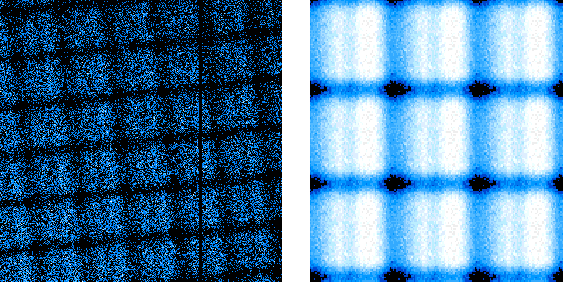
Analysis of the data begins with selecting suitable grade events (single pixel and horizontally or vertically split events) from the photo-peak of the monochromatic line to build the moiré cells, rotating the moiré cells, and summing individual cells into one representative pixel (hereafter RP) for the entire CCD. Figure 4.38 shows a sample of the unrotated, raw moiré cells that are a direct output of the illumination of the mesh/CCD system and the RP, repeated in a 3x3 array to make it easy to see the boundary regions of the pixel. With the RP generated, determination of the sub-pixel structure can proceed. By compressing the RP in one direction, the attenuating affect of the channel stops or the gates can be modeled. For the rest of this review, we concentrate only on the channel stops, although the same techniques can be applied to measure the gates.
 |
The approach for determining the channel stop dimensions is quite straightforward.
The attenuation in detected photons expected from the channel stop (recall that the Slab and
Stop Model assumes that any photon interacting in the sub-pixel structure
will not be detected) is convolved with the PSF of the mesh holes. The
resultant convolution is compared to the experimental data, and the
channel stop model parameters are allowed to vary, using a  fit
statistic to determine the best-fit parameters.
Figure 4.39 shows the five parameters used to describe the channel stop.
Compare the
model to the SEM photo of an actual channel stop in Figure 4.35.
fit
statistic to determine the best-fit parameters.
Figure 4.39 shows the five parameters used to describe the channel stop.
Compare the
model to the SEM photo of an actual channel stop in Figure 4.35.
In addition to constructing a realistic channel stop model, the success
of this technique depends on providing an accurate PSF for the mesh and
accounting for additional processes that effectively broadens the PSF
(i.e. diffraction, diffusion
of the charge cloud, distortions to the PSF caused by using a non-parallel X-ray
source). Producing such an analytic aperture function (hereafter AF) is a
daunting task.
Fortunately, the AF can be ascertained from the mesh data itself.
Horizontal and vertical split events come from photons that interact within
an electron cloud size diameter of the pixel boundary. Analysis of
BESSY KMC data performed by Jones and Prigozhin [Jones and Prigozhin1997] indicate
that cloud sizes range between 10 and 100 nm. The distribution of the
horizontal and vertical split events ( ), then, is the
convolution of a 10-100 nm step function (
), then, is the
convolution of a 10-100 nm step function ( ) with the AF.
 |
(27) |
in diameter,
so can be approximated as a  function. Equation 4.15
then becomes
function. Equation 4.15
then becomes
 |
(28) |
Mark Bautz