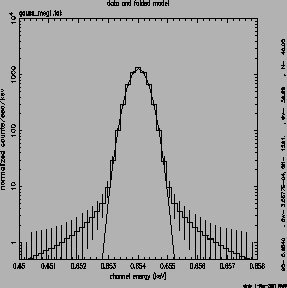
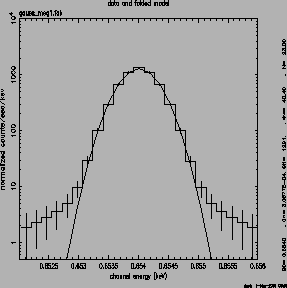
The effects of fitting a Gaussian function to a line spread
function which is more complex, a Gaussian core with Lorentzian
conponent for the wings, can result in a narrower Gaussian than
would be obtained by using the more complete Gaussian plus
Lorentzian function.
To demonstrate this effect a simulation was generated using a
delta function convolved with the RMF for the first order MEG which
has both the Gaussian and Lorentzian component. This function was
then fit with a Gaussian that was not convolved with the RMF so
that the wings would not appear. The region over which the fit
was performed was decreased so that only the core was being fit.
The columns in table 1 are the energy range being fit, the best
fit sigma of the simple Gaussian fit and the absolute value of  %
%
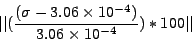
assuming that the widest energy range is the true Gaussian width.
| Energy Range | Gaussian  |
|
| 0.650 - 0.658 | 3.06 10 10 |
 |
| 0.652 - 0.656 | 3.0610 |
0.0% |
| 0.653 - 0.655 | 3.0410 |
0.6% |
| 0.6532 - 0.6545 | 2.9210 |
4.6% |
| 0.6535 - 0.6543 | 2.7710 |
9.5% |