SLh5 is a S-Lang module for the HDF5 file format and software library.
HDF5 is widely used in large scale science and engineering projects --
such as the FLASH simulator of thermonuclear explosions in stars
(
http://www.flash.uchicago.edu/website/home/) --
because it combines data and compiler portability with very high
performance, scalability to terabyte-size datasets, and support for
parallel I/O. The S-Lang interpreter is part of the widely-used,
open-source library of the same name, and provides a scripting environment
well-suited for scientific and engineering tasks, due to the powerful,
compact, fast, and robust multidimensional numerical capabilities that
are native to the language.
SLh5 provides a high-level interface to HDF5, supporting the easy creation of S-Lang arrays from HDF5 files or vice versa. The entire HDF5 api is presented in terms of 6 simple functions:
        h5_new   -  create one or more new HDF5 files
        h5_open  -  open one or more HDF5 files/groups/datasets/attributes
        h5_close -  close one or more HDF5 files

        h5_read  -  read one or more datasets or attributes
        h5_write -  write a dataset or attribute
        h5_list  -  browse an HDF5 container (analogous to h5dump utility)
With SLh5 users may thus interact with HDF5 files in scriptable analysis enviroments such as ISIS ( http://space.mit.edu/cxc/isis/), with substantially smaller and cleaner code than is possible in other analysis platforms, e.g. IDL (tm), and with potentially considerable I/O performance advantages.
The present implementation is incomplete, with the major gaps being that partial I/O is not yet supported, and that compound types -- i.e. structures -- may be read but not written. S-Lang version 2.0.6 or later is required.
SLh5 can be loaded at runtime into any suitably configured application which embeds the S-Lang interpreter, using either
require("h5");
() = evalfile("h5");
        x = [-50:50];
        y = x^2;
        z = x^3;
        attr = "StringAttribute";
        file = "test.h5";
        file_id = h5_new(file);
        h5_write(file_id, x, "x");
        h5_write(file_id, y, "y");
        h5_write(file_id, z, "z");
        dataset_id = H5Dopen(file_id, "z");
        h5_write(dataset_id, attr, "attr", H5I_ATTR);
        h5_close(file_id);
x2 = h5_read(file, "x");
        file_id = h5_open(file);
        y2 = h5_read(file_id, "y");
attr2 = h5_read("test.h5:/z","attr");
test.h5 file and the z dataset,
using an identifier for the latter as the location from which the
attr attribute will be read. This is equivalent to
attr2 = h5_read("test.h5","/z/attr");
        f = h5_open("test.h5");
        d = H5Dopen(f, "z");
        attr2 = h5_read(d, "attr");
        d = h5_open("test.h5:/z");
        attr2 = h5_read(d, "attr");
The correctness of the above HDF5 I/O calls may be easily verified through
        any( x != x2 );
        any( y != y2 );
        attr == attr2;
just_two = h5_read("test.h5", ["y","x"]);
x and y dataset arrays, in reverse write order,
while both
three_1 = h5_read("test.h5", ["x","y","z"]);
three_2 = h5_read("test.h5", "*");
        any( three_1[0] != three_2[0]);
        any( y != three_1[1]);
        any(three_1[2] != three_2[2] or three_2[2] != z);
Now let's look at some scientific examples using the ISIS (
http://space.mit.edu/cxc/isis/)
astrophysical modeling and analysis system (and assuming
Isis_Append_Semicolon = 1). Consider
isis> slab = urand(10, 30, 50)
        isis>  slab
        Double_Type[10,30,50]
volview, our prototype 3D volume visualizer, to get an
idea of what this slab looks like:
        isis>  require("volview")
        isis>  volview(slab)

isis> h5_write("slab.h5", slab)
isis> slab_copy = h5_read("slab.h5")
        isis>  any(slab != slab_copy)
        0
    define cone()
    {
       variable r, h, nsteps;
       switch(_NARGS)
       { case 3: (r, h, nsteps) = (); }
       { usage("cone(radius, height, number_of_steps)"); }

       r = r * 1.0; h = h * 1.0;
       variable hsteps = [ 0.0 : h : h / nsteps ];
       variable rsteps = (r*hsteps/h)^2;
       variable xysteps = [-r: r: 2*r/nsteps]^2, xsq = xysteps;
       nsteps = length(xysteps);
       variable c = Double_Type[length(rsteps), nsteps, nsteps];

       variable i = 0;
       foreach(rsteps) {
          variable rsq = ();
          variable j = 0;
          foreach (xysteps) {
             variable ysq = ();
             c[i, j, *]  = (ysq + xsq <= rsq);
             j++;
          }
          i++;
       }
       return c;
    }
isis> c = cone(5, 10, 200)
        isis>  c
        Double_Type[200,200,200]
volview
isis> volview(c)
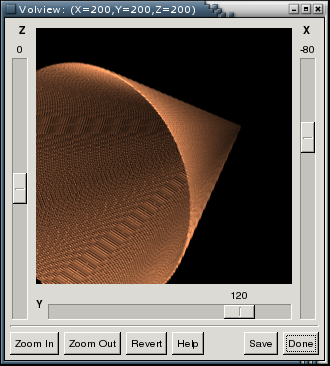
        isis>  h5_write("cone.h5", c)
        isis>  cone_copy = h5_read("cone.h5")
        isis>  any(c != cone_copy)
        0
Additional examples may be found in the regression test subdirectory
(./tests) of the SLh5 distribution.