Thermal Plasma Fitting/Simulation Demo
dph Wed Oct 24 2001
I have written some user models which allow an APED plasma to be binned and fit in ISIS. NOTE: global fitting can be a useful start to spectral analysis, but is NOT the end!
The ISIS script, Aped_model_demo.sl walks through a session in which a thermal plasma model from APED is fit to II Peg, which has a strong, hot coronal emission line spectrum. (see Huenemoerder et al, 2001, 2001 ApJ 559,1135.)
The script is meant to be used in a cut-and-paste fashion, possibly with edits as appropriate for the data loaded (consistent set of PHA, ARF, and RMF files).
The plasma models are written as ISIS user models in the file, aped_fit_models.sl. The relevant functions are:
- aped_multi_fit();
- aped_multi_init();
- aped_multi_setup();
- aped_set_abund();
Elemental abundances are not parameters of the model, but they may optionally be altered. aped_set_abund() stores values in an array read by the user-model function.
(NOTE: the script uses the functions rplot and fakeit, which wer recent additions to ISIS and which are not in the ciao-importable version.)
Several plots are made by the script as shown below. They can be found in the script by searching for Aped_model_demo_.
First, an ad hoc model is defined, evaluated, and plotted to see if it is close. Then the fit is run on the short wavelength region where the high-temperature component dominates.
This is the result to fitting HEG and MEG plus and minus 1st orders simultaneously (output parameters are listed in the script, as well as commands which made the figure).
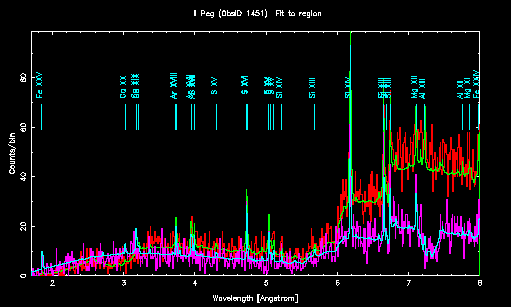
Next, the hot component is frozen, a longer wavelength region is "noticed" (exclusively), where there are stronger lines from cooler plasma, and the fit is run again. Then, the all bins are "noticed" at full resolution, and the model evaluated.

We can also simulate the spectrum with a "fakeit" command, and we obtain the following picture:
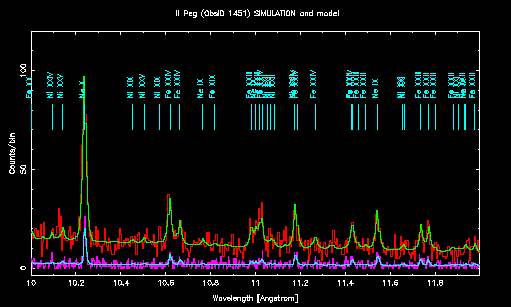
I have shown regions in which the fit looks reasonable. It is left as
an exercise for the reader to find regions where the fit is not good,
or even close. Three temperatures are definitely not enough to
characterize the II Pegasi X-ray spectrum.
{Please send comments to: dph@space.mit.edu}