8/19/99, 11pm
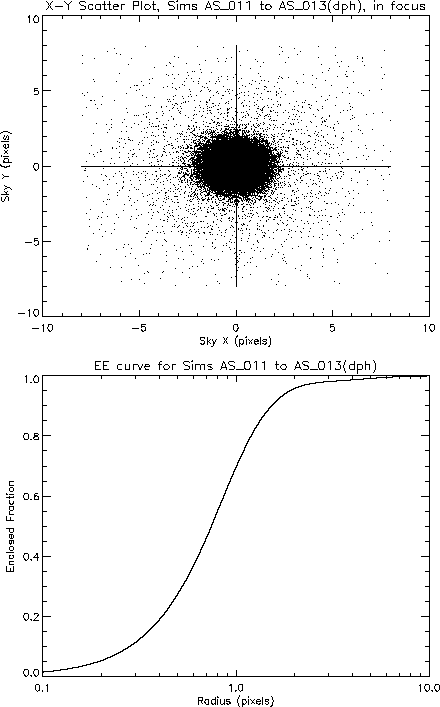
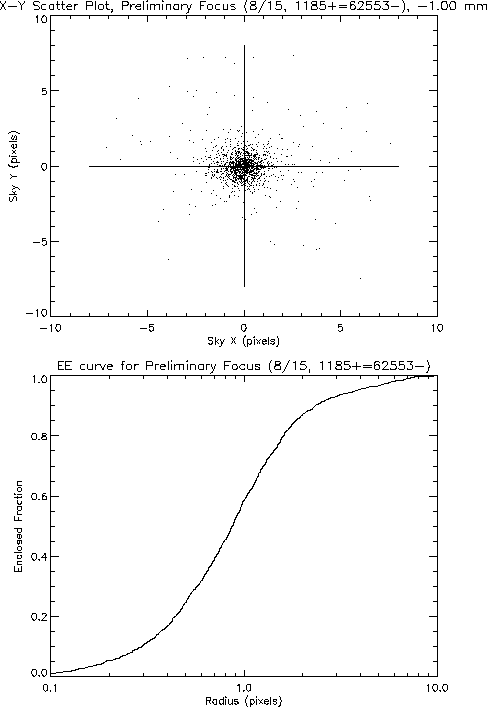
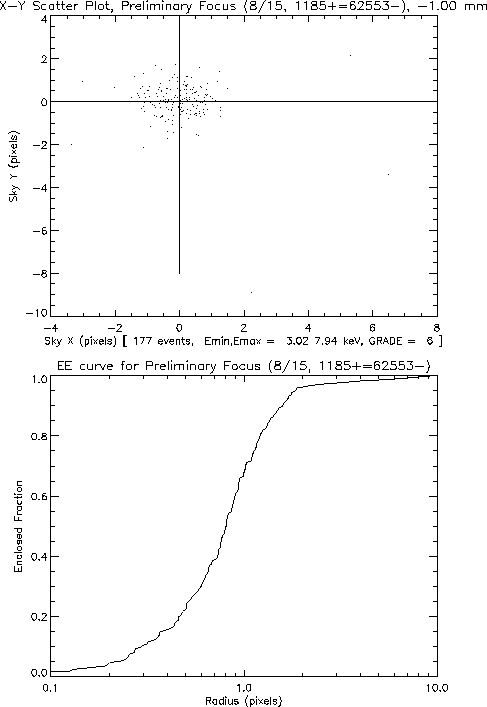
Here I present the expected Encircled Energy curve and measured ones: the expected half count radius of 0.35 arc seconds is not too much smaller than measured values of 0.42 and 0.38 (0.5 to 2 keV and 3.0 to 8.0 keV.)
The curve shown here is from a MARX simulation of an on-axis point source with a Capella spectrum. The simulation was created by Dave H by taking a MARX ray-trace with dither and running the grating level 1.5 tools on the marx2fits output file. As such this simulation includes realistic ACIS pixel quantization, aspect reconstruction, and CXCDS analysis effects.
The EE curve shows 5%, 20%, 50%, 80%, and 95% encircled counts at radii of 0.2, 0.42, 0.74, 1.20, and 1.8 pixels or, in arcsec radius: 0.096, 0.202, 0.355, 0.576, 0.864. Energies in the 0.5 to 2.0 keV range are used.
The EE curves shown here are from the focus = -1.00 mm measurement in the preliminary plate focus, obsid 62553. The 0.5 to 2.0 keV G02346 curve is a bit wider than the 3.0 to 8.0 keV G6 curve; note that these curves are not too dissimilar from the expectation, e.g, with 50% EE radii at 0.87 and 0.80 pixels respectively, compared with 0.74 for the expectation.
8/19/99
The HETGS line response function (LRF) depends on the HRMA PSF and grating properties. This page collects PSF analysis of relevance to the HETGS.
Please send any comments to
Dan Dewey at dd@space.mit.edu.