


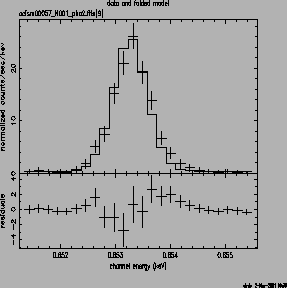
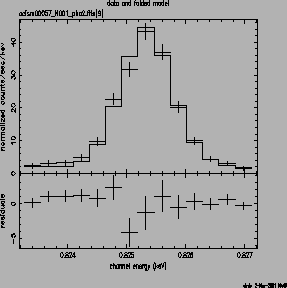
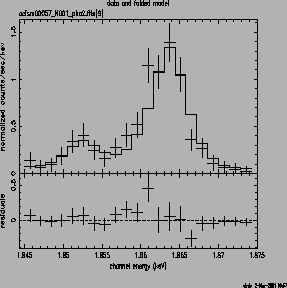
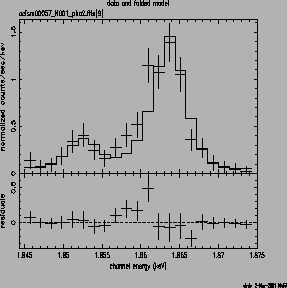
Here I compare the fits obtained using the Capella HETG data
(acism00057_N001_pha2.fits) for the MEG -1 order using RMFs
from 1) my fits to the MARX simultions, meg1_test.rmf
and 2) using Dan's slightly narrower Gaussian component,
meg1_new.rmf. In both cases the
Lorentzian component was that I originally derived from the
MARX simulations. The observational data has an exposure time
of 31856.15 seconds and was processed with CIAO 2.0_Beta on
Monday, November 6, 2000. The fits to the data were done
using the APEC model in XPSEC so account for weak lines and
any continuum in the region of interest. The initial parameters
for the fit are kT = 0.6 keV and solar abundance. The temperature, abundance
and in some cases the redshift was allowed to vary. The variable
redshift was to account for slight differences in the tablulated
and measured line positions. In none of these fits did I try
to constrain the physics of Capella, for instance the HEG and
MEG fits of the Fe line at 826 ev (15.01 Å) were not constrained
to have the same kT and abundance. In fact for the narrow energy
range being fit here there are many combinations of temperature
and abundance that result in a formally acceptable fit to the
data.
In all the cases tested here the reduced chi squared statistic
( ) is formally accpetable. The for the iron
line at 15.01 Åhas the highest of the three lines
however, this line also lies in a crowded region of the spectrum.
) is formally accpetable. The for the iron
line at 15.01 Åhas the highest of the three lines
however, this line also lies in a crowded region of the spectrum.

|
|

|
|
|
|
 = 10.937,
dof=20,
= 10.937,
dof=20,