David Huenemoerder
20 June 1997
|
The AXAF transmission gratings, HETG or LETG, are typically used with
the ACIS-S and HRC-S detector arrays, respectively. The data can be processed
to a point without any dependence upon the gratings. This is referred to
as "Level 1": it is primarily a scaling and formatting of the
event data and ancillary descriptive information about the observation
("meta-data"). After Level 1, "Level 2" processing
is defined as analysis of source properties, such as source detection,
fluxes, or extent. Grating data require a bit of analysis in order to provide
the basic spectral properties of each photon: its diffraction angle, wavelength,
and if possible, a diffraction order. This is referred to as "Level
1.5", since it must be done before spectral analysis. This document
is intended to provide a basic overview of these steps.
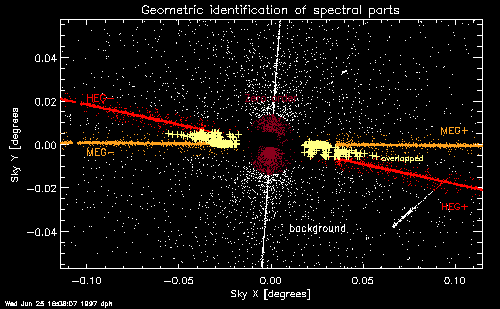
Figure 1below shows a block diagram of the fundamental steps, of which boxes 3-6 comprise Level 1.5 processing. Much of the processing has been implemented for XRCF. However, XRCF and flight processing are somewhat different, primarily in the use of aspect dither in which the spacecraft pointing is driven on a Lissajous pattern on the sky, and in the possibility of multiple sources in the field. One XRCF observation, that of a continuum source ("Molecular Contamination" test) observed with the HETG and ACIS-S has been used to prototype flight processing. Each of the boxes in the block diagram will be described in more detail, with accompanying graphical examples derived from the test data. AXAF spectroscopic data are obtained as event lists. Each step in the processing maintains the event-list format, and the final Level 1.5 product is an event list. Furthermore, an effort is being made to avoid truncation of data by imposing grids; since the pointing is moving continuously during an observation, there is no well defined "pixel" size for the resulting data. Analysis may follow by binning event-lists into counts spectra, or may be used in maximum-likelihood methods. |
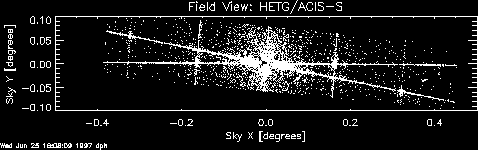
This is a scatterplot of photon positions, and not an intensity image. The zero-order photons lie in the dense region near the center of the image. The two arms of the "X" are the HEG and MEG parts of the HETG spectrum. The aspect ratio is approximately 1:1. This was a heavily exposed image and suffers from some problems: bright lines leave tails (approximately vertical stripes) due to exposure during frame-transfer (an ACIS PSF "feature"!) , and no event-grade filtering has been done. |
|
|
|
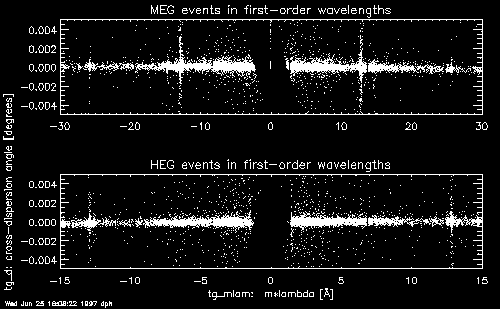
to determine m*lambda for each photon. Here, m is the integral diffraction order, and P is the mean period of the set of gratings (MEG, HEG, LEG). A picture in m*lambda space looks much like the above (Figure 5). |
|
|
|
The prototype final product is an event-list with the following columns: |
| TIME | DOUBLE |
| CCD_ID | INT |
| CHIPX | INT |
| CHIPY | INT |
| TDETX | INT |
| TDETY | INT |
| DETX | INT |
| DETY | INT |
| X | FLOAT |
| Y | FLOAT |
| PHA | LONG |
| PI | LONG |
| GRADE | INT |
| FLTGRADE | INT |
| TG_PART_MAP | LONG |
| TG_R | FLOAT |
| TG_D | FLOAT |
| TG_MLAM | FLOAT |
| TG_ORDER | INT |
| TG_LAM | FLOAT |
|
The Level 1.5 additions begin with "TG_PART_MAP". Some ofthese definitions are subject to change. There are currently issues pending resolution on the use of floats vs longs. A sample FITS bintable can befound in TBS. |
David Huenemoerder
(617-253-4283; fax: -0861)
Center for Space Research /AXAF
Science Center
MIT 37-667, Cambridge, MA 02139
dph@space.mit.edu